


The Rip is a thriller that will keep you guessing right up to the end.
- Denise Breen

- Feb 13
- 4 min read
Rating: ★★★★☆ (4/5)
Written by Denise Breen

There is a specific kind of cinematic shorthand that occurs when Ben Affleck and Matt Damon share the screen. It’s a lived-in, effortless chemistry that can’t be manufactured by even the most meticulous casting directors. In Netflix’s latest high-octane crime thriller, The Rip, directed by the king of gritty testosterone cinema, Joe Carnahan, this chemistry isn't just a nostalgic perk—it’s the very engine that keeps a familiar "crooked cop" premise firing on all cylinders.
Before diving into the humid, neon-soaked streets of Miami, it’s worth noting the machinery behind the film which is currently streaming on Netflix. The Rip serves as a prominent showcase for Artists Equity, the production company founded by Affleck and Damon. Their mission—to create a more equitable profit-sharing model for cast and crew while prioritizing mid-to-high budget adult dramas—is palpable here.

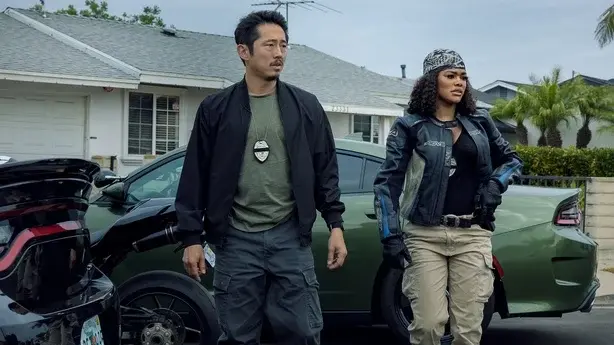
This isn't a "contractual obligation" streaming movie. It feels like a project born from a genuine desire to revitalize the mid-budget studio thriller. You can see the quality in the details: the oppressive humidity of the Hialeah locations, the razor-sharp editing, and a supporting cast that includes Steven Yeun, Teyana Taylor, and a chillingly bureaucratic Kyle Chandler. As producers, Affleck and Damon have curated a film that looks and feels more substantial than the average "straight-to-digital" fare, proving that their partnership is as much about business acumen as it is about creative synergy.
While the film’s narrative—a "Tactical Narcotics Team" (TNT) that stumbles upon a staggering fortune—feels like the stuff of 90s pulp fiction, The Rip is actually inspired by true events. The script draws from the real-life 2016 raid led by Miami-Dade Police Captain Chris Casiano.
In reality, Casiano’s squad discovered roughly $24 million in drug money hidden behind a false wall in a suburban attic, stuffed into industrial-sized buckets. The film recreates this discovery with visceral tension, using the same "money-sniffing dog" and sledgehammer tactics that defined the actual bust. However, where the real-life story ended with a record-breaking seizure and a legal victory against a money launderer, Carnahan’s film takes a darker, more Shakespearean turn.
By layering the "what if" of police corruption over the "what was" of the actual raid, the film explores the psychological toll of standing in a room with $20 million while your life—and the lives of your partners—are falling apart.

Matt Damon stars as Lieutenant Dane Dumars, a character loosely modeled on Casiano. Damon brings a quiet, simmering grief to the role; his character is mourning the loss of his young son to leukemia (a tragic detail also drawn from Casiano's real life). This grief provides the "beating heart" of the film, as Joe Carnahan has noted in interviews. It transforms Dane from a generic action hero into a man whose moral compass is spinning because he has nothing left to lose.
Opposite him is Ben Affleck as Detective Sergeant J.D. Byrne. Affleck is in his element here, playing a character that balances "Southie" swagger with a creeping sense of paranoia. If Damon is the film's soul, Affleck is its adrenaline. Their friendship, spanning over four decades in the real world, translates into a fictional partnership defined by unspoken trust and, eventually, devastating suspicion.
The "buddy cop" trope is subverted when the titular "rip"—the act of stealing the seized cash—becomes a wedge between them. Watching these two navigate a pressure-cooker environment where every glance is scrutinized for betrayal is the film's greatest strength. They aren't just acting like old friends; they are old friends, and that history makes the stakes feel incredibly personal.
Joe Carnahan’s direction is, as expected, brash and confident. He traps the team inside a nondescript house in Hialeah, surrounded by a cartel-controlled neighborhood that feels like a modern-day Alamo. The cinematography by Juan Miguel Azpiroz uses tight frames and low-light palettes to amplify the claustrophobia.
The film's midpoint—the actual counting of the money—is a masterclass in tension. As the characters are forced by protocol to count the $20 million twice by hand, the sheer weight of the physical cash starts to erode their ethics. It’s a slow-burn sequence that highlights the "unbearable reality" of greed.

Don't get me wrong, The Rip isn't perfect. The script occasionally leans into "tough guy" platitudes that border on the cliché, and the female characters, despite strong performances from Teyana Taylor and Sasha Calle, occasionally feel sidelined by the overwhelming "bro-energy" of the leads. Additionally, the final act takes a few narrative leaps that require a significant suspension of disbelief.
However, these are minor gripes when compared to the film’s overall impact. It is a propulsive, intelligent, and emotionally grounded thriller. It succeeds because it understands that the most interesting part of a heist isn't the money—it’s the people who decide whether or not to take it.

The Rip is a triumph for Artists Equity and a reminder of why Affleck and Damon remain the gold standard for Hollywood collaborations. It’s a gritty watch that manages to be both a pulse-pounding action flick and a sombre meditation on grief and greed.
If you’re looking for a film that combines the "lived-in history" of its stars with the visceral grit of a true-crime legend, The Rip is essential viewing. It’s a reminder that even in a world of endless streaming content, true star power and a great story can still cut through the noise.


Comments