


Send Help, Sam Raimi's corporate satire is a bloody, beautiful return to form
- Denise Breen

- Feb 9
- 4 min read
Rating: ★★★★☆ (4/5)
Author: Denise Breen

There is a specific, visceral joy in watching a Sam Raimi movie that feels like a Sam Raimi movie. After a decade largely spent playing in the sandboxes of Marvel and Disney, the director has finally returned to the scrappy, mean-spirited, and splatstick roots that made Evil Dead II and Drag Me to Hell genre touchstones. His latest offering, Send Help (2026), is not a perfect film—it is occasionally shaggy, tonally schizophrenic, and suffers from a mid-movie lull—but it is undeniably, jubilantly alive. It is a survival thriller that treats class warfare with the subtlety of a sledgehammer and the energy of a Looney Tunes cartoon, anchored by two performances that are destined to be the most meme-able of the year.
The premise is high-concept simplicity, the kind that used to dominate the mid-90s thriller market. Linda Liddle (Rachel McAdams) is the backbone of Preston Strategic Solutions, a hyper-competent corporate strategist whose career is currently being suffocated by the glass ceiling. That ceiling is reinforced by Bradley Preston (Dylan O’Brien), the CEO who inherited the company from his father and treats Linda like a gloriously overqualified personal assistant.

The script, penned by horror veterans Damian Shannon and Mark Swift, wastes no time in making us hate Bradley. He is a cocktail of unearned confidence and casual misogyny, the kind of guy who interrupts you to explain your own idea back to you incorrectly. When a private jet taking them to a merger in Bangkok goes down in a storm (a sequence that is pure, sensory-overload Raimi), Linda and Bradley wash up on a deserted island in the Gulf of Thailand.
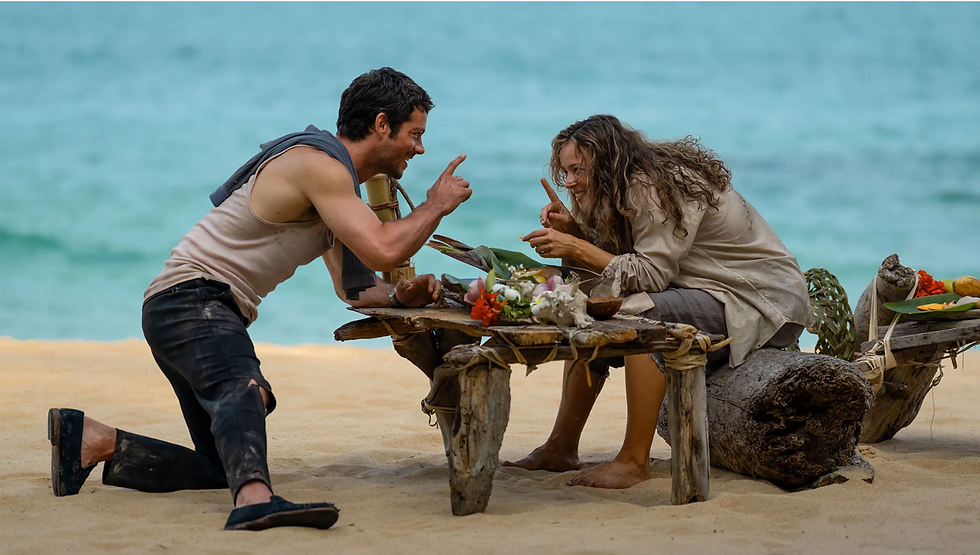
Here, the dynamic flips. Linda, a closet survivalist who spends her weekends watching Survivor, studying edible flora and knot-tying, becomes the de facto captain. Bradley, whose survival skills are limited to ordering Uber Eats and firing people, becomes the dead weight.

The film lives and dies on the chemistry between McAdams and O’Brien, and thankfully, they are electric.
Rachel McAdams has always possessed a frantic, screwball energy that Hollywood rarely utilizes correctly (see Game Night for the exception). In Send Help, she is unleashed. Linda starts as a coil of repressed rage, her polite smiles twitching at the corners. Once they hit the island, McAdams transforms. There is a scene, roughly forty minutes in, where Linda successfully starts a fire while Bradley whines about his cell service. The look of feral, triumphant ecstasy on McAdams’ face is worth the price of admission alone. She plays Linda not just as a hero, but as someone who is terrified by how much she is enjoying the power shift.

Dylan O’Brien, meanwhile, is having the time of his life playing the absolute worst person you know. He leans into Bradley’s cowardice with a wonderful physical comedy. He is rubber-faced and pathetic, shrieking at crabs and slipping in mud with a lack of dignity that is truly brave for a leading man. O'Brien manages the difficult trick of making Bradley detestable yet pitiable enough that you don't check out of the movie; you stay because you want to see exactly what indignity befalls him next.

Visually, Send Help is a masterclass in kinetic filmmaking. The camera is rarely still. It swoops through the jungle canopy, chases characters at ankle-level, and tilts aggressively during moments of psychological snapping. There is a delirious montage of Linda building a shelter that is shot with the manic intensity of a montage from Army of Darkness, complete with rapid zooms and exaggerated sound design.
And, of course, there are the fluids. This is a 4-star review, but be warned: if you have a weak stomach, this might be a 2-star experience. Raimi has lost none of his love for "splatstick." The island is not a paradise; it is a wet, sticky, hostile organism. Characters are vomited on, bled on, and covered in unidentifiable muck. There is a sequence involving a wild boar that feels like a direct spiritual successor to the goat scene in Drag Me to Hell—gross, hilarious, and genuinely tense all at once.
However, the film’s reliance on CGI for some of the animal interactions (specifically that boar) is one of its few technical stumbles. In a movie that feels so tactile and practical, the glossy sheen of a digital creature stands out poorly. One wishes Raimi had gone full animatronic, even if it looked fake—at least it would have looked Raimi fake.

While the marketing sold Send Help as a straight horror-thriller, it plays much more like a pitch-black satire. The horror here isn't the elements; it's the realization of how little your boss values your life.
The script is surprisingly sharp on corporate codependency. Even as they starve, Bradley tries to "manage" Linda, offering her promotions he can't grant and using HR speak to critique her shelter-building techniques. It’s a biting commentary on how corporate structures are so deeply ingrained that we try to apply them even when we are literal castaways. The island strips away the suits and the titles, revealing the terrifying truth: without the artificial hierarchy of capitalism, the Bradleys of the world are food.
If there is a reason Send Help falls short of a 5-star masterpiece, it is the second act. After the initial thrill of the crash and the establishment of the new island order, the film spins its wheels for about fifteen minutes. The repetitive cycle of "Bradley messes up, Linda fixes it, they argue" starts to lose its novelty. The psychological warfare needed to escalate faster than it did.
Additionally, a late-game twist—which I will not spoil—feels slightly derivative of other "stranded" thrillers. While Raimi executes it with flair, savvy genre fans will likely see the narrative pivot coming from a mile away. It doesn't ruin the movie, but it does deflate the tension slightly right before the explosive finale.
Despite a sagging middle and some dodgy CGI, Send Help is a riotous return to form for Sam Raimi. It is a film that understands exactly what it is: a B-movie premise elevated by A-list talent and A-plus direction. It balances legitimate survival tension with laugh-out-loud slapstick, never taking itself too seriously but always taking its characters' plight seriously enough to keep the stakes high.
For fans of Evil Dead, Drag Me to Hell, or just watching awful corporate-types get their comeuppance, this is essential viewing. It’s the first great horror-comedy of 2026, and a reminder that nobody—absolutely nobody—tortures their actors quite like Sam Raimi.


Comments