


Project Hail Mary – A Celestial Buddy Comedy with Scientific Soul
- Denise Breen

- Mar 15
- 5 min read

Rating: ★★★★☆
Written by Denise Breen
I read Andy Weir's space odyssey and loved it, even if the science was quite heavy-going in places. Bringing the "Project Hail Mary" text to the silver screen was always going to be a "suicide mission" of sorts. How do you translate a 500-page book where the protagonist spends half his time doing long-form calculus into a two-hour cinematic experience? Directors Phil Lord and Christopher Miller have answered that question by leaning into the heart, the humour, and a heavy dose of Hollywood charm, even if they had to jettison some of the technical ballast to keep the ship moving.

Let’s get the big one out of the way: Ryan Gosling is Ryland Grace. If there was any doubt that Gosling could carry a film while essentially trapped in a tin can, he obliterates it. He captures Grace’s specific brand of "terrified-but-curious" energy perfectly. He manages to make the character's transition from a confused amnesiac to a desperate saviour feel earned and deeply human. Gosling’s comedic timing—especially during those first awkward attempts at communication with a certain five-legged co-star—provides the film's "beating heart" that was so missing in other recent sci-fi attempts. It is perfect casting.
As with Andy Weir's earlier book, "The Martian" there is a lot of internal dialogue. For the film adaptation of that book, Matt Damon just said those thoughts out loud to himself. Most of us understood the need to plant and grow potatoes. For fans of the "Project Hail Mary" book, the film’s approach to the "hard" science will be the main point of contention. Weir’s novel was a love letter to the scientific method, where every problem was solved with a slide rule and a lab beaker. By skipping the dense physics and the minute-by-minute chemistry of the Astrophage, the film maintains a breakneck pace. It’s a thrill ride that never bogs down in the "math."

However, this streamlining makes the narrative feel slightly disjointed. Because the film glosses over the "how," the solutions can occasionally feel like "movie magic" rather than hard-won victories. If you haven't read the book, you might find yourself wondering why Grace is suddenly building a neutrino detector out of spare parts. Being a reader definitely provides the "connective tissue" that the script lacks.
One area where the film stumbles slightly is the sense of scale. In the novel, the "Astrophage" isn't just a space problem; it’s an Earth-ending catastrophe that sees the entire world uniting in a desperate, frantic scramble for survival. The "Project Hail Mary" of the book felt like a global titan. In the film adaptation, the focus is narrowed so tightly on Grace that we lose that feeling of the world coming together. The scenes back on Earth, while well-acted (particularly by a steely Sandra Hüller as Stratt), feel a bit "small." You don't quite feel the weight of eight billion people holding their breath; you just feel the weight of one man in a cockpit.

Visually, the film is a triumph. The depiction of the Hail Mary and the surrounding star systems is crisp, tactile, and terrifyingly vast. And then there is Rocky. The creature design and the way the film handles their non-verbal communication is nothing short of brilliant. It avoids the "cute alien" tropes and delivers something truly alien yet deeply relatable. Their friendship is the soul of the movie, and it’s rendered with a warmth that makes the final act hit incredibly hard.

Project Hail Mary is a rare breed: a "smart" blockbuster. While it sacrifices some of the book’s intellectual rigour for the sake of momentum, it keeps the spirit of the source material intact. It’s a story about the power of curiosity and the beauty of friendship across the stars. Read the book first to understand the "why," then go to the theatre to see Ryan Gosling show you the "who."
Spoiler below, or for those who have read the book, a discussion on how the ending is changed:
In comparing the final moments of the film to Andy Weir’s novel, the directors clearly had to choose between scientific closure and emotional resonance. While the book ends on a note of peaceful, educational irony, the film pushes for a more "cinematic" sense of awe.
Here is how the two versions of the ending diverge:
1. The Decision to Turn Around
In both versions, the "Climax of Character" is the same: Ryland Grace realises that while the Earth is saved (thanks to the Taumoeba being sent back), his friend Rocky is doomed because his fuel is contaminated.
The Book focuses heavily on the logistics of the sacrifice. We spend pages with Grace calculating the fuel, the trajectory, and the grim reality that he will likely die of starvation on an alien planet because he gave his food to the Taumoeba.
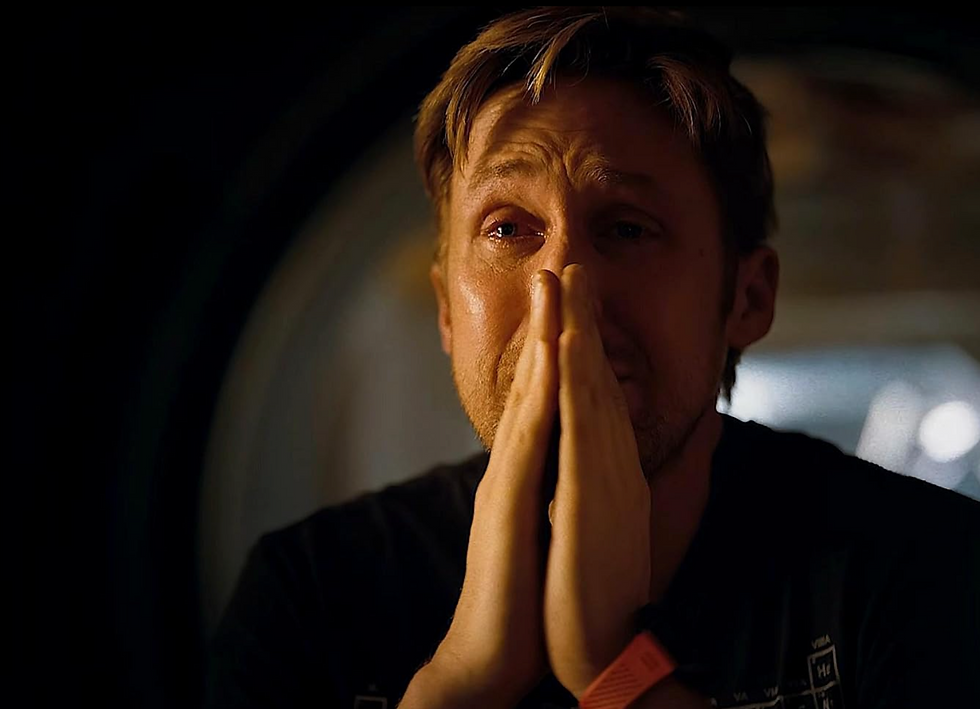
The Film uses Gosling’s performance to sell the emotional weight. The movie speeds up the "math" of the turnaround to focus on the look on Grace's face when he realizes he can't let his "fist-bump" companion die alone. It feels more like a heroic rescue mission than a calculated death sentence.
2. The Fate of Earth
This is where the film feels a bit "disjointed," regarding the scale of the problem.
In the book, there is a beautiful, tense sequence where we see Earth through a "long-range" lens. We get confirmation that the sun is brightening again via the Taumaoeba sent back. It feels like a hard-won victory for a global team.
The film relies on a montage. We see flashes of Earth—green returning to frozen landscapes and people looking at the sky. It’s visually stunning but, because the film didn't establish the global desperation as well as the book, this "save the world" moment feels a little less earned. It feels like a "happily ever after" rather than a narrow escape from extinction.
3. The "Classroom" Ending
Both the book and the film keep the iconic final scene: Ryland Grace, older and settled, teaching a group of Eridian children.
The Difference in Tone: The book’s ending is famously humorous. Grace is a bit of a "cranky" teacher, annoyed that the Eridian kids aren't paying enough attention to his biology lessons. It’s a very "Andy Weir" way to end—grounded, funny, and intellectual.
The Film's Visuals: The 2026 film goes for Scale and Wonder. The camera pulls back from the classroom to show the domes of the Eridian city under the dim light of 40 Eridani. It’s a breathtaking shot that emphasizes that Grace didn't just survive; he became the first human to truly join another civilization. It trades the book's "teacher humour" for a sense of "cosmic legacy."
4. The Final "Rocky" Interaction
The film gives us one last moment between Grace and Rocky that the book leaves largely to our imagination. In the movie, we see an elderly, "leaky" Rocky (looking a bit more grey/metallic) watching Grace teach. It provides a visual closure to their friendship that the book handles through prose.
If you loved the book, the film's ending might feel a little "rushed" because it misses the internal monologue of Grace accepting his own death. However, seeing the visuals of Erid—the high-gravity, high-pressure world—makes the sacrifice feel much more tangible. The book makes you feel the smartness of the choice; the movie makes you feel the loneliness (and eventual belonging) of the choice.



Comments