Wicker is Woven Together with Mixed Success


Rating: ★★★☆☆ (3 out of 5 stars)
Adapted from Ursula Wills-Jones’s short story The Wicker Husband, directors Alex Huston Fischer and Eleanor Wilson bring a distinct, folkloric oddity to the screen. Wicker transports audiences to an indeterminate, storybook past—presumably a medieval era where conformity is law and isolation is a crime punishable by public ridicule. In this timeless, rustic settlement, nobody possesses a proper given name. Instead, the inhabitants are defined entirely by their trade or their social relationship to one another: there is the Baker, the Butcher, the Tailor, and our central protagonist, an ostracized, pungent local outcast known simply as the Fisherwoman.
Tired of being the butt of cruel village jokes and enduring a life entirely devoid of affection, the Fisherwoman takes an extraordinary leap of imagination. She approaches the village’s resident artisan, the Basket Weaver, commissioning him to craft a husband for her.

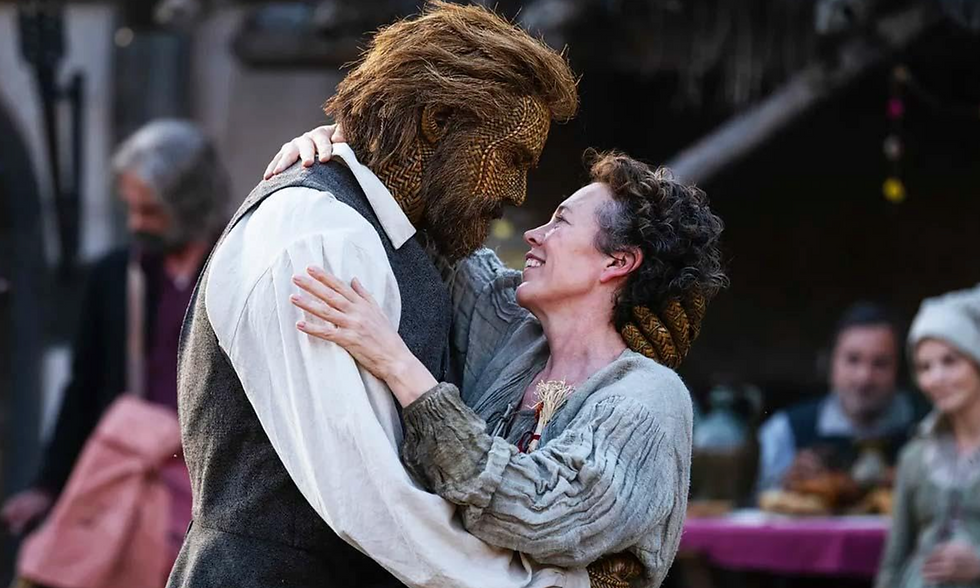
At the centre of this bizarre cinematic experiment is Olivia Colman, who plays the Fisherwoman with her customary, unbridled commitment. Colman is an absolute treasure, clearly having the time of her life navigating the material's eccentric blend of raw vulnerability and broad, physical comedy. Whether she is reacting with wide-eyed, goggle-eyed astonishment to the unexpected physical perks of her unorthodox domestic arrangement or standing her ground against a chorus of judgmental whispers, Colman grounds the film's wild premise with genuine warmth. Her performance ensures that even as the narrative dips into surrealism, the emotional core remains entirely human.

Equally compelling is Alexander Skarsgård, an actor who continues to take remarkable professional risks by seeking out challenging, out-of-the-box roles. Here, Skarsgård portrays the titular Wicker Husband—a towering, cross-hatched creation brought to life through intricate practical effects and prosthetics. Constrained beneath a mask and a full body suit of woven willow, Skarsgård manages to convey an astonishing degree of tender, non-toxic sweetness and genuine romantic devotion. Playing a character entirely devoid of inner conflict or malice is a sharp pivot for an actor so frequently drawn to brooding intensity, and Skarsgård pulls it off with quiet grace.
The domestic bliss of this unconventional couple rapidly stirs a cauldron of venomous envy among the rest of the village. Chief among the detractors is the tailor's wife, played with magnificent relish by Elizabeth Debicki. Debicki clearly enjoys playing the innocent yet deeply conniving homemaker, slipping effortlessly into a posture of polite neighbourhood graciousness while actively plotting the downfall of the happy household. Her sharp-faced, calculating presence introduces a simmering tension that threatens to unravel the fragile peace of the community.
Guiding us through this peculiar landscape with a wry, knowing wink is Peter Dinklage as the Basket Weaver. Dinklage delivers a standout supporting performance, functioning as the story’s narrator and ultimate moral arbiter. Operating from his secluded workshop where "Mother Nature provides, I merely augment", Dinklage anchors the fable's whimsical logic, eventually stepping in to resolve the chaos he inadvertently helped set into motion.
Despite these stellar turns, Wicker occasionally struggles to maintain its momentum over its 105-minute runtime. The central premise, while delightfully inventive on paper, hits narrative speed bumps in the middle act as the satirical barbs aimed at small-town hypocrisy begin to repeat themselves. The whimsical tone occasionally clashes with the darker, folk-horror undertones, leaving the pacing somewhat uneven.
Ultimately, Wicker is a bold, visually striking experiment that relies heavily on the sheer magnetism of its principal cast. It may not completely master its own eccentric mythos, but its willingness to embrace the absurd makes it a memorable cinematic trip.


Comments